Rev. Jesse Jackson’s Bay Area political impact, from the 1984 convention to labor and civil-rights marches
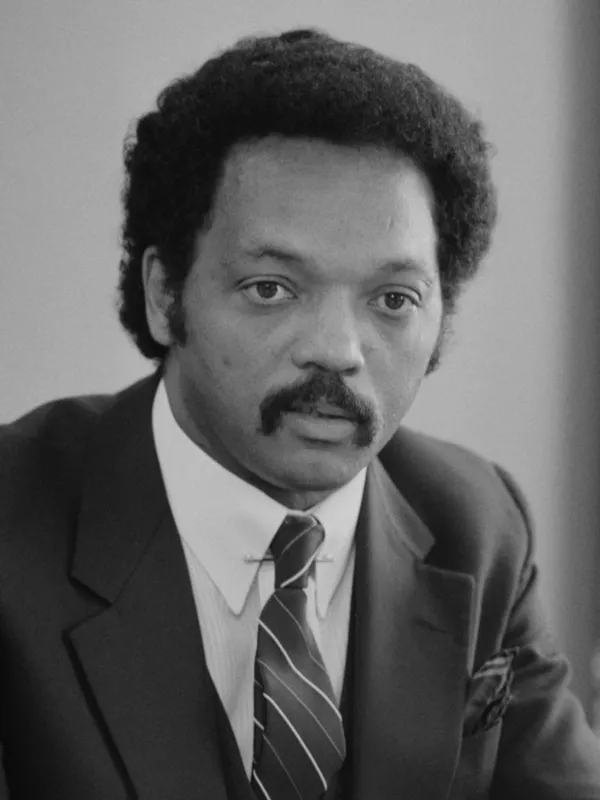
A Bay Area chapter in a national civil-rights and political career
Rev. Jesse Jackson’s relationship with the Bay Area spanned landmark moments in national Democratic politics and repeated appearances in local movements focused on labor rights, civil rights, and public safety. His presence in San Francisco and the wider region became most visible in the 1980s, when Northern California served as a national political stage during the Democratic Party’s presidential nominating contests and party conventions.
The 1984 Democratic National Convention in San Francisco
Jackson delivered a widely remembered address during the 1984 Democratic National Convention at the Moscone Center in San Francisco, held July 16–19. His speech framed a multiracial, multi-issue political alliance often described as a “Rainbow Coalition,” emphasizing inclusion across race, ethnicity, faith, gender, disability status, and sexual orientation. The 1984 convention ultimately nominated Walter Mondale for president and Geraldine Ferraro for vice president, with Jackson finishing third in delegate counts behind Mondale and Gary Hart.
The convention week placed Jackson’s coalition message before a national audience while tying it to a specific San Francisco setting that would be revisited in later political and civic conversations in the city.
California political ties and Willie Brown’s role
Jackson’s later presidential run reinforced his connections to California Democratic leadership. In the late 1980s, then–California Assembly Speaker Willie Brown of San Francisco took a formal role in Jackson’s national campaign leadership. The association highlighted how Jackson’s national campaigns interacted with prominent Bay Area political figures who were influential within California’s Democratic Party structure.
Labor activism in San Francisco and the region
Beyond electoral politics, Jackson appeared repeatedly in Bay Area labor actions. He marched with San Francisco hotel workers during a major 2004 labor dispute centered on wages and health benefits, joining a rally that drew thousands and amplified the union’s message in the city’s civic core.
In the broader region, Jackson also addressed large gatherings connected to the Watsonville Cannery strike during the mid-1980s, a prolonged labor conflict in Santa Cruz County that drew substantial Bay Area support. His participation linked local labor fights to national narratives about worker rights and economic justice.
Civil-rights mobilizations and Bay Area public demonstrations
Jackson also joined major Bay Area public demonstrations tied to civil-rights policy debates. In August 1997, he participated in a high-profile protest that included a march across the Golden Gate Bridge as Proposition 209—California’s ban on affirmative action in public employment, education, and contracting—took effect.
Public safety advocacy and later Bay Area appearances
Jackson returned to the East Bay in the 2000s to address gun-violence concerns, calling for stronger limits on assault weapons and community-based pressure on gun retailers. The appearance illustrated how his Bay Area role extended beyond campaigns and into issue-based advocacy years after his national presidential bids.
- 1984: Convention-stage speech in San Francisco that elevated an inclusion-focused coalition message.
- Late 1980s: Formal campaign ties with prominent San Francisco Democratic leadership.
- 1980s–2000s: Participation in labor rallies and strikes affecting Bay Area workers.
- 1990s–2000s: Appearances in major demonstrations and public-safety advocacy in the region.
Taken together, these events form a consistent pattern: Jackson’s Bay Area impact was expressed through moments when national politics, local organizing, and large-scale public mobilization converged in San Francisco and across the region.