San Francisco homeowners commission murals to enhance curb appeal, as value impact remains hard to measure
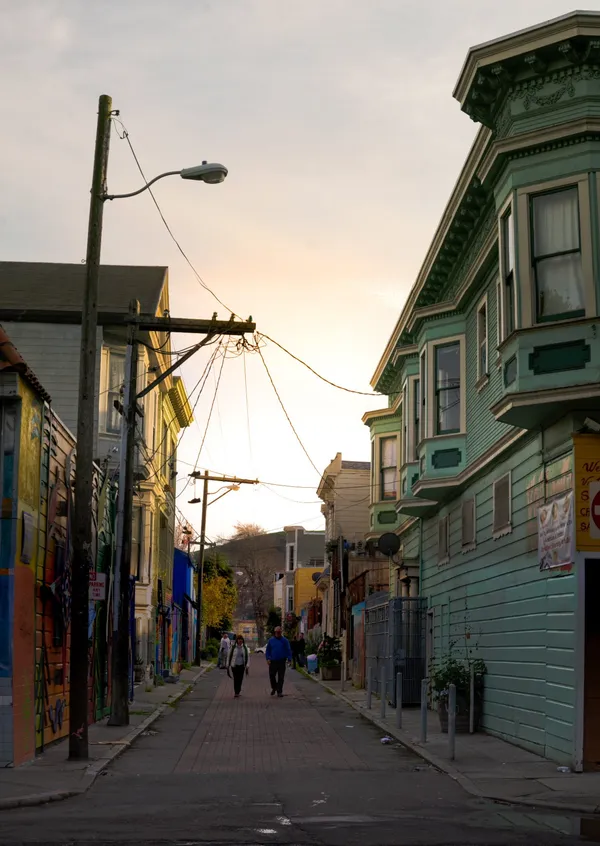
Murals are moving from public alleys to private facades
Across San Francisco, murals long associated with the Mission District’s celebrated outdoor galleries are increasingly appearing on privately owned homes, garages, and small residential buildings. Homeowners say they are commissioning large-scale artwork to refresh aging exteriors, deter repeat graffiti tagging, and give otherwise similar properties a distinctive identity on dense blocks.
The trend taps into a citywide mural ecosystem that ranges from landmark corridors to newer, privately funded projects. In the Mission, Balmy Alley developed a reputation in the 1970s and 1980s for densely packed murals responding to social and political themes, while Clarion Alley’s rotating works have been a prominent site for community-driven art since the early 1990s. Those public-facing precedents have helped normalize murals as a familiar part of the city’s visual landscape.
What homeowners must navigate before paint goes on a wall
In most cases, a mural on private property that is paid for with private funds does not require design approval from the San Francisco Arts Commission. However, city approval is required when murals are placed on City-owned property or financed in whole or in part with City funds. Separate permits or approvals may also be needed depending on location and site conditions, and city guidance emphasizes steps to reduce conflicts between artists and property owners.
- Ownership and funding source determine whether Arts Commission design approval is required.
- Property owners may need to coordinate with city departments responsible for the site or adjacent public space.
- Project planning often includes defining whether the work is intended as temporary or permanent.
Does a mural raise a home’s value? Evidence is mixed and highly local
The financial case for murals is harder to pin down than the aesthetic one. Residential real estate values are typically driven by fundamentals such as location, unit size, condition, parking, outdoor space, and broader market cycles—factors that can dwarf the incremental effect of a painted exterior.
Research on street art’s relationship to property prices suggests that the impact varies by context, visibility, and the kind of artwork involved. Some quantitative studies have found price premiums associated with certain forms of street art in specific settings, while also reporting no statistically significant effect for murals in other cases. Separately, housing-market analyses have noted that murals are appearing more frequently in for-sale listings, but frequency does not establish that murals reliably add resale value.
Local market dynamics further complicate any claim of a consistent payoff. A mural that is broadly admired could improve first impressions and buyer interest; another could narrow the pool of buyers who prefer neutral exteriors or who anticipate maintenance and repainting costs.
Practical considerations that affect costs and outcomes
Homeowners and artists commonly plan for long-term upkeep, including sun exposure, moisture, surface preparation, and protective coatings. In neighborhoods where murals draw visitors, property owners may also weigh privacy, foot traffic, and the risk of defacement. These factors can shape whether a mural functions as a lasting asset, a periodic maintenance obligation, or simply a personal design choice.
Murals can change a home’s visibility overnight, but translating visibility into predictable resale value remains difficult in San Francisco’s complex housing market.
For now, the most verifiable conclusion is narrow: murals are becoming a more common residential design choice in San Francisco, while the effect on property value remains uncertain and case-specific.